As I’ve mentioned many times before, dressage is hard. You know how I know it’s hard? Because a large number of people who train in the sport seek out shortcuts. What do I mean by shortcuts? Shortcuts can be a number of things, but most frequently it’s the use of training aids, as well as riding “front to back,” meaning they try to impact the horse’s way of going through their contact in the bridle, versus getting the horse to use their body so that the movement and carriage goes from the hind end.
It can be arduous and frustrating to navigate a horse’s training, so I can see why shortcuts are SO tempting. I mean, if you can slap on a training aid and get the same results as you would after months and months of trying to finesse the horse’s movement through incremental training, why wouldn’t you do it? Well, because the results aren’t actually the same taking shortcuts as they are when you actually train movement properly.
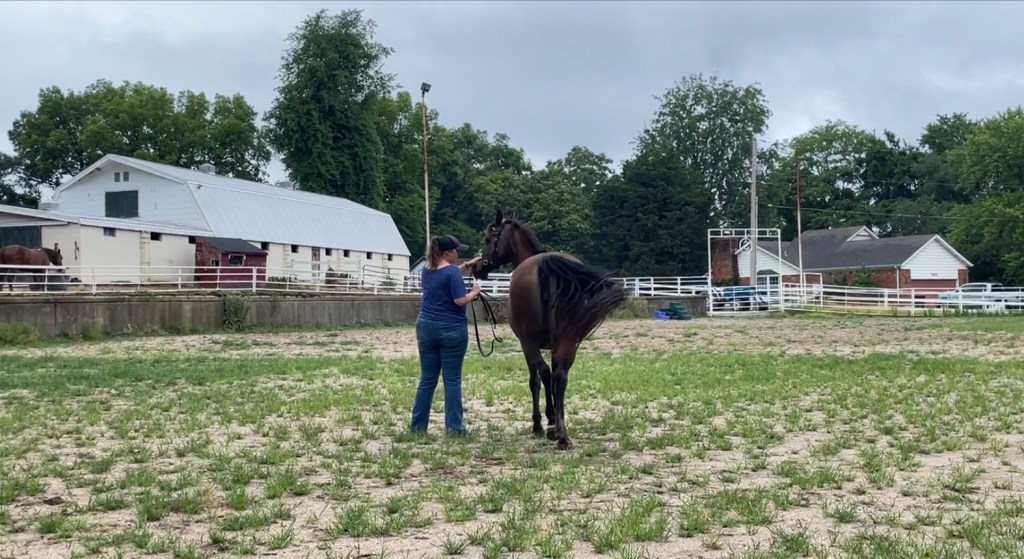
For one thing, a training aid is making up for 1) the horse’s lack of understanding of what you actually want, and 2) the horse’s physical weaknesses that prevent them from carrying their body the way you want. It’s not going to instantly create better communication between you, the trainer, and your horse; nor is it going to instantly create a muscle where before there was none. So, you don’t have real training going on here, just compliance. And, once the horse is forced into a position and they don’t have the muscle to hold that position, other muscles will step up to compensate. This may mean you’re actually making your horse crooked or giving them more physical problems later on.
Whether you’re using training aids or holding the horse’s face in to help them keep their balance, you’re not teaching them proper movement. Proper movement means they engage their core, use their hind end to properly send energy up and forward, and lift through their shoulders, while their head and neck receive that energy and bascule downward and forward into the bridle with a light contact. It takes a lot of training and learning to communicate. With that, you get frustration and a non-linear journey forward. Still, over time, the rewards are huge if you go down this path.
The past few rides on Kiss have been SO different from where we started. She is much more trusting of me to help show her the way to balance and she is less inclined to panic and get hollow in her back and rush forward as a result. Her trot is much more relaxed and even. And the thing is, the more you practice proper movement, the more you reinforce it.
Kiss is also much easier to ride when she is balanced. When her head is up and she’s careening around the arena with a hollow back, it’s easy to feel like a kitten on roller skates up there. Like, okay, I know I’m getting back into riding and I’m not great, but there’s a difference between refining your riding skills and feeling like a total beginner because your horse is a mess.
There are SO many advantages to taking the slow and steady road to proper movement and training that I haven’t even been able to touch on everything, nor am I qualified to talk about everything, but if you’re on this path and you’re tempted to jump ship and go for an easy fix, stay the course. It’s worth it.
 Equicurious