One of the things about being a 40-something re-rider that is the source of much insecurity for many of us is our equitation. Some people are blessed with graceful, athletic bodies that are able to have just the right angles for doing everything that is needed for a perfect riding seat, but the majority of us have to work at it.
I’ve really decided to do my best at working on my seat. We all know my “rider profile”: 43 years old, curvy build, desk job, otherwise fairly active. My first step has been doubling down on my physiotherapy exercises: deep core work that includes bilateral and co-lateral moves, as well as glute strength. I should do these every day, but right now every other day is the best I can do with everything else I am trying to cram in. Next has been flexibility, so doing stretches alongside my PT and also doing a deep stretch yoga class once a week.
I’d been going along and doing those things for a bit, which also helped my running. Since I’ve been doing these exercises regularly, I have not experienced one bit of IT band pain, so that is important to note. I believe they’ve helped me in my riding stability, but I didn’t think they were helping me get all the way to where I wanted to be.
So, that’s when I decided to do some lunge lessons with my friend, Christen, who owns Calling Bird Farm LLC, which is a small barn west of St. Louis, MO that offers private lunge lessons and programs for kids. If you want to be humbled as a rider, go take a lunge lesson with someone who knows what they’re doing and find all of your weaknesses. During my last lesson, we worked on stirrup stands at the trot and I found that slight shifts in my stirrup position drastically helped my stability.
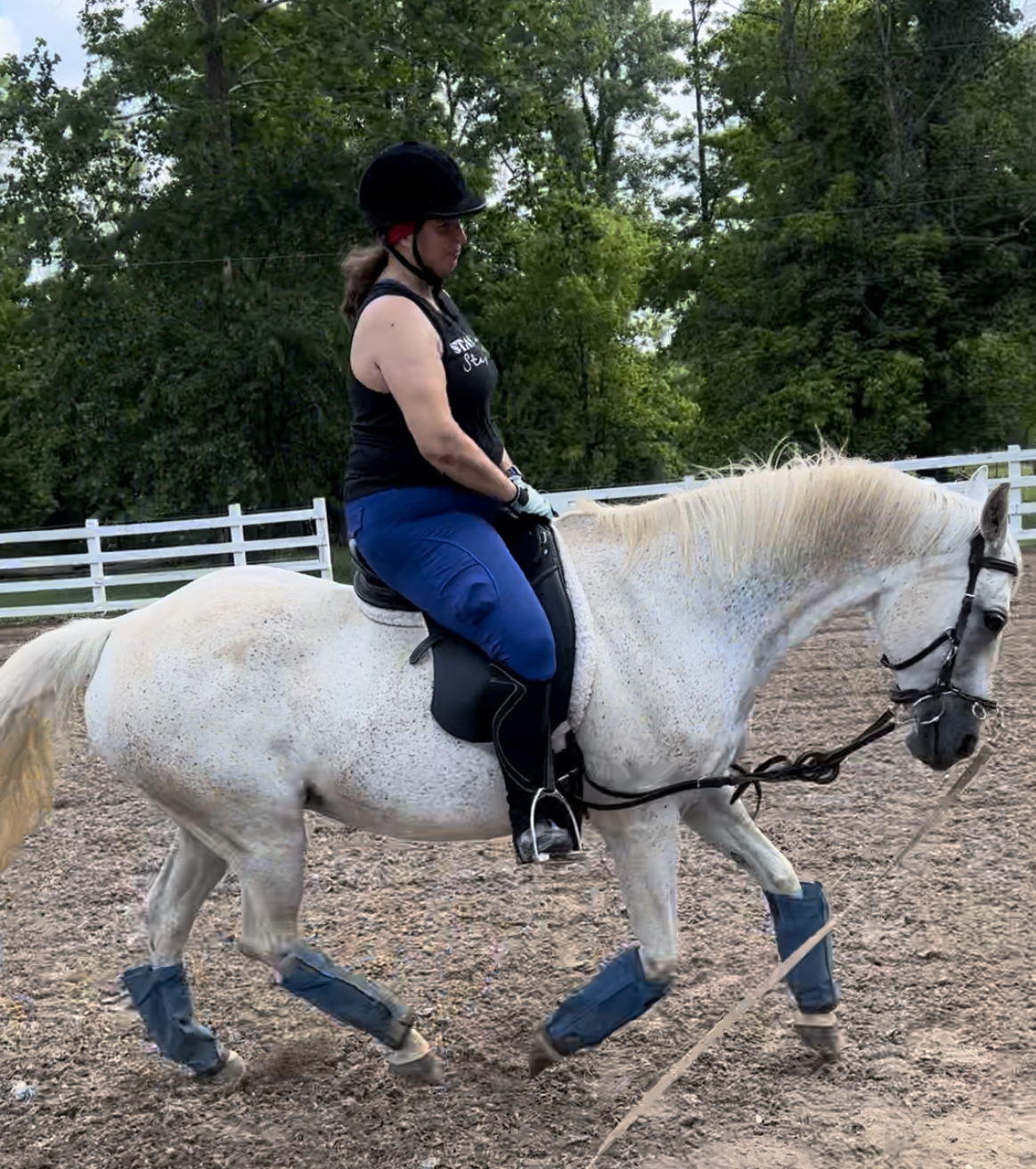
Along with adding lunge lessons and PT exercises, plus the yoga class, I decided to attend Karin Miles’ Neurorider clinic at Shade Tree Stables, hosted by my trainer, Deanna Preis. Using neurological theory and techniques to activate different areas of the brain, Karin is able to help people improve their mobility, strength, balance, perception, and vision; all of which help dramatically to improve people’s riding. She can tell what your issues are just by watching you move and through a series of deductive tests to narrow down the treatment modality. It was amazing to watch other people improve in a matter of seconds!
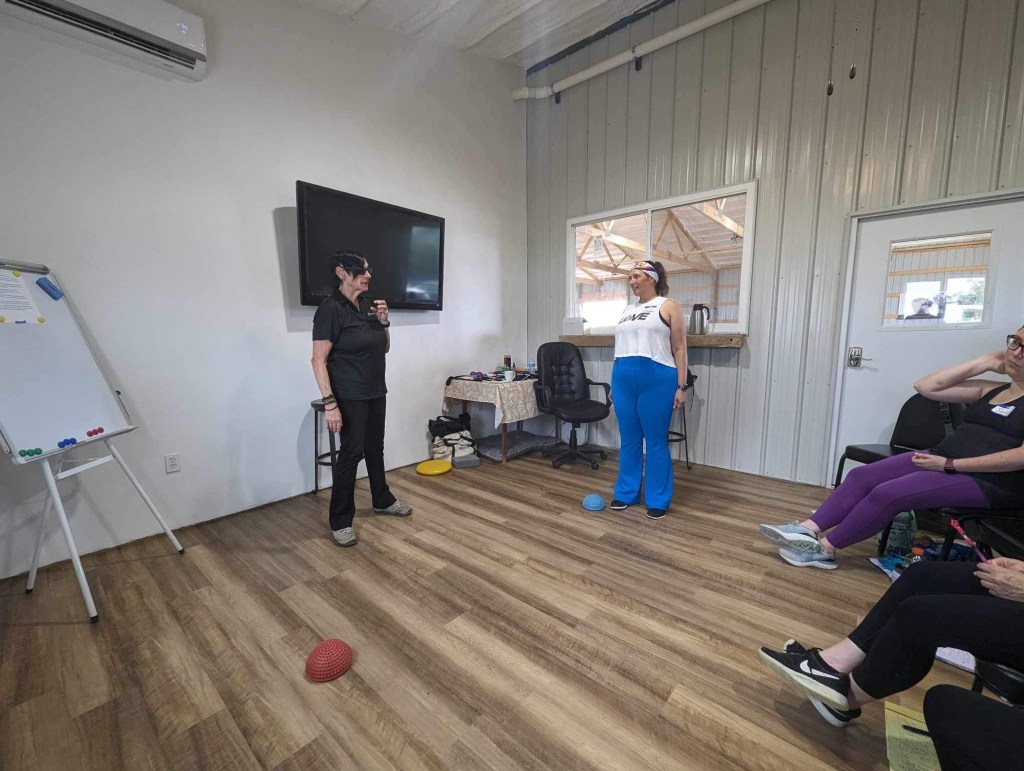
When I stepped up and did the initial test, which was essentially doing a figure 8 through some cones while keeping my eyes fixed on a target, it was clear that I had some serious proprioception issues. Proprioception is our brain’s function of sensing the location and movement of our body parts, in particular our perceptions of our joint movement and muscle effort and force. I know that I absolutely don’t trust anything my lower body is doing, so that has always been a huge issue for me.
However, when she had me bend over to touch the floor, she saw that my hips were incredibly wonky. Yep, my fall really knocked me out of wack. The force onto the right hip caused by left hip to be higher, which would create a spiral seat in the saddle. A spiral seat is really bad because your hips can force the saddle over to put pressure on the horse’s spine, plus it can throw the horse off balance.
So, ultimately, instead of working through my proprioception issues, she decided to help adjust my hips. So, she actually manually adjusted me (she is a chiropractor, so she can do that), and then she had me go through a series of exercises, so that I could be more even. This helped me a ton and reminded me that I needed to go see a body worker. I made an appointment for October to someone my friend recommended highly.
My next ride felt more balanced and Kiss was extremely relaxed, although what Deanna and I are discovering is that Kiss’s imbalance throws me out of wack and vice versa. She has a weak left hind leg, which she avoids placing under her center of mass when she walks on the circle. This throws her barrel and back over to the left, shifting me off of my left seat bone and onto my right seat bone. In order to shift her ribcage and back to the right to create a bend around the circle, her leg has to come under her and my weight has to be on the left seat bone. But that’s terribly hard if you’re fighting against gravity. It’s a process, but I have confidence we’ll get things adjusted.

Ultimately, it’s so incredibly important to work on your athleticism as a rider. If you expect strength and agility out of the horse, you have to create it in yourself first. You can’t expect to be carried around like a princess in a saddle throne, you have to put in the work. And, believe me, the work isn’t easy. That said, the more I work on my athleticism, the more confident I get up there. I worry less about the “what ifs” because I know that I have more and more security and stability. And I think getting a fall “out of the way,” no matter how painful it was, was helpful in reassuring me that falling isn’t the end of the world. Hopefully, next time, I avoid whacking a major nerve.
 Equicurious